
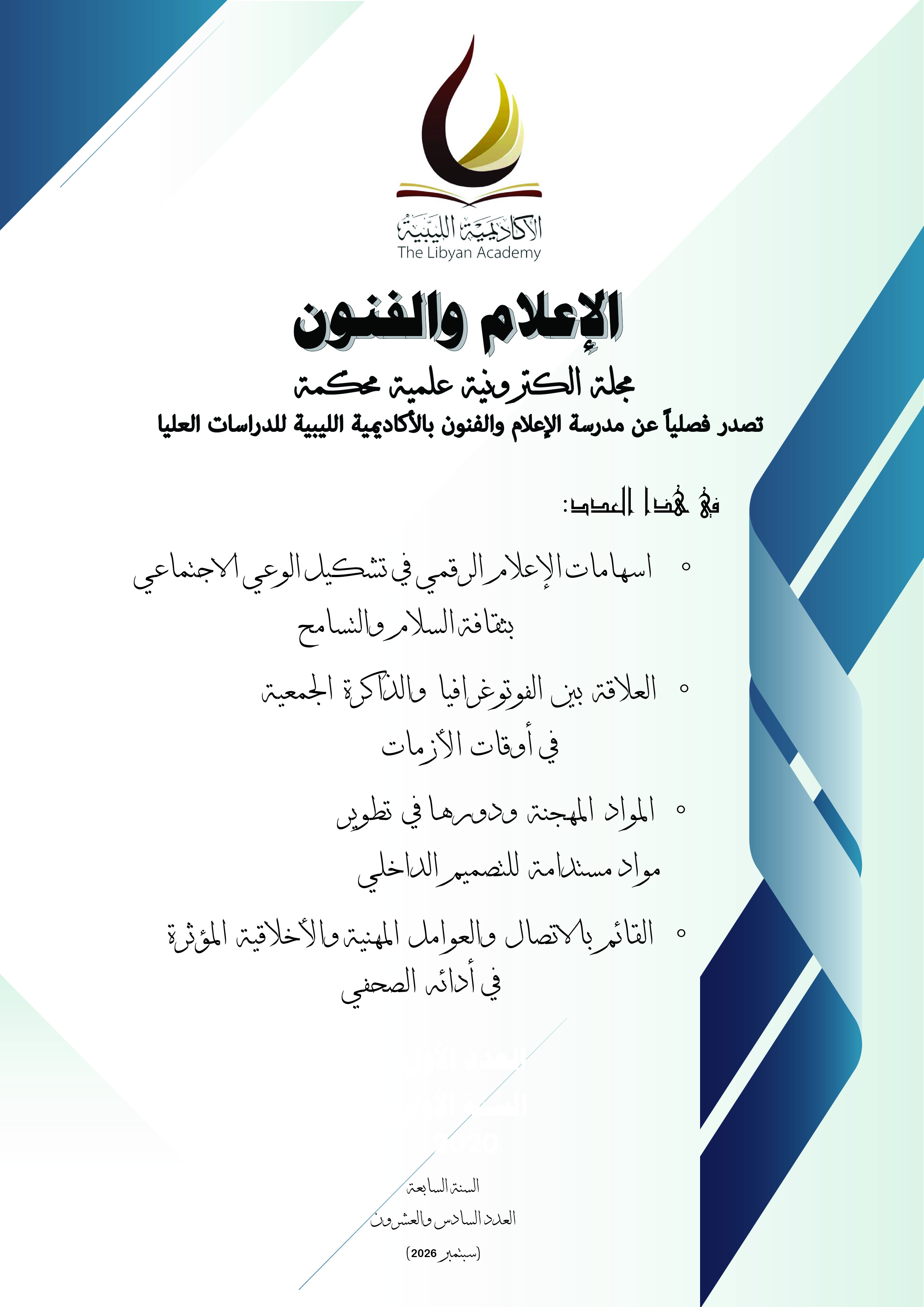
اسهامات الإعلام الرقمي في تشكيل الوعي الاجتماعي بثقافة السلام والتسامح
Article Sidebar
Main Article Content
Abstract
Study Summary
The problem addressed by this study is the contribution of digital media to shaping social awareness of a culture of peace and tolerance. This is achieved by focusing on the principle of social responsibility of digital media in defining the extent of respondents' awareness of a culture of peace and tolerance, highlighting the most important issues related to this culture that digital media has contributed to shaping respondents' awareness of, and identifying the obstacles that limit the effectiveness of digital media in this regard and ways to address them. The study relies on three main concepts: digital media, social awareness, and a culture of peace and tolerance. Its theoretical approach is based on media dependency theory. The study is descriptive in nature and employed a media survey methodology with a purposive sample of 400 digital media users in Benghazi. The data collection tool was a questionnaire. The study yielded the following results:
- “Harmony, understanding, peaceful coexistence, and forgiveness of individuals” tops the list of meanings that express a culture of peace and tolerance, at a rate of (31%); followed by “establishing human relations on the basis of societal stability” at a rate of (26.5%), and then “mutual recognition of the other to achieve social peace and political stability” at a rate of (17.5%) of the respondents.
- The most important issues of the culture of peace and tolerance discussed by digital media are: (a) “Rejecting violence and extremism” at a rate of (26.3%), (b) “Societal security and stability” at a rate of (24%), and (c) “Rights and freedoms” at a rate of (18.8%) of the total sample.
- - The most prominent digital media that contributed to shaping social awareness of issues of the culture of peace and tolerance are: (a) Facebook at a rate of (13.8%), (b) News websites at a rate of (11.1%), and (c) YouTube at a rate of (11.1%) of the respondents.
- The most significant obstacles that limit the contributions of digital media in shaping social awareness of the culture of peace and tolerance are embodied in: (a) “Unregulated media practices” at a rate of (16.7%), (b) “The dissemination of information that contributes to the spread of intolerance and hatred of others” at a rate of (15.6%), (c) “The exaggeration in disseminating knowledge about events of violence and crime” at a rate of (14.9%) of the total sample.
Article Details

This work is licensed under a Creative Commons Attribution-NonCommercial-NoDerivatives 4.0 International License.